
Overview
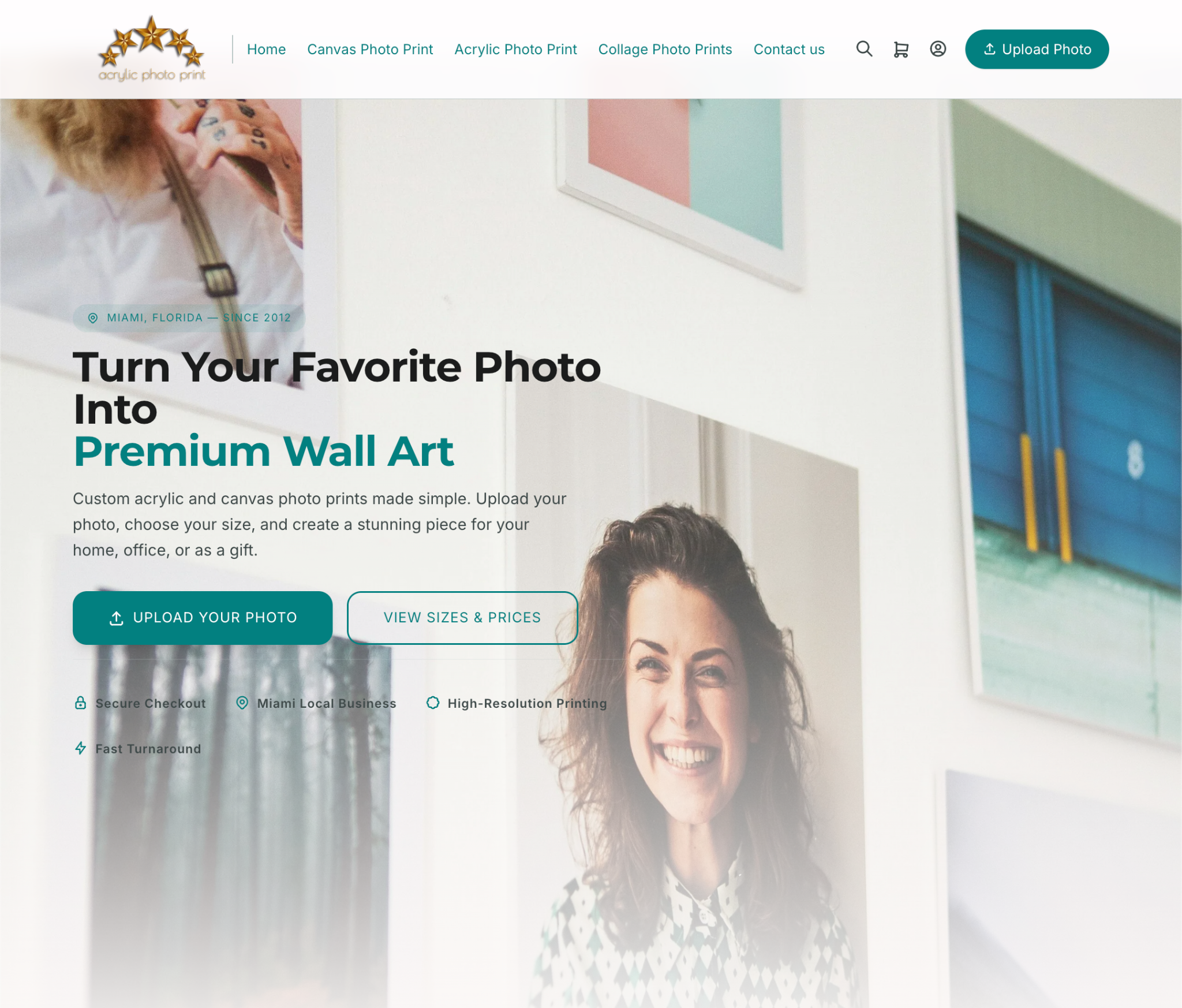
AcrylicPhotoPrint sells personalized acrylic photo prints — every order starts with a customer-uploaded image, which makes it a product-personalization platform first and an e-commerce store second.
The Challenge
Stock WooCommerce assumes a fixed, pre-defined product catalog. This store needed customers to upload their own images, preview them on the product, and have that image travel correctly through cart, checkout, and fulfillment — all without breaking WooCommerce’s own assumptions about what a “product” is.
My Role
I own the platform end to end: custom plugin development, WooCommerce customization, the image pipeline, and — more recently — the architectural rebuild of the storefront.
Architecture
Custom plugins extend WooCommerce’s product, cart, and order data to carry an uploaded image and its processing metadata alongside the standard product data. The storefront itself was rebuilt on WordPress + Timber + Twig + Svelte + Tailwind CSS — WordPress and WooCommerce remain the content and commerce engine, Timber/Twig cleanly separate PHP logic from markup, and Svelte handles the interactive parts of the experience (image upload, live preview, personalization UI) without turning the whole frontend into a single-page app.
Technical Implementation
- Custom cart and checkout logic to validate and persist uploaded images through the full order lifecycle.
- An image processing pipeline for resizing, format conversion, and print-ready output, with assets served through Cloudflare in front of AWS.
- Shipping integration reflecting the physical constraints of framed acrylic prints (weight, packaging, carrier rules).
- Twig templates replacing legacy PHP template files, giving the theme a maintainable separation between logic and presentation.
Engineering Challenges
Personalized, image-based products break most WooCommerce performance assumptions: large file uploads at checkout, image processing that can’t block the request, and product pages that need to feel instant despite doing real work behind the scenes.
Solution
Image processing happens off the critical checkout path, with Cloudflare handling asset delivery so processed images load fast regardless of origin load. The Svelte-driven personalization UI keeps the interactive parts snappy while the rest of the page stays server-rendered through Timber/Twig.
Performance / Security / Scalability
AWS for storage and processing, Cloudflare for caching and delivery, and a template architecture (Timber/Twig) that keeps the codebase maintainable as the catalog and customization options grow.
Results
A production e-commerce platform built around a workflow WooCommerce doesn’t support out of the box, now running on an architecture that reflects current WordPress engineering practice rather than a legacy monolithic theme.
Key Takeaways
The project demonstrates WordPress as an engineering platform: a modern interactive layer in Svelte, a maintainable Timber/Twig template architecture, and commerce logic that extends WooCommerce beyond its standard product model.